When an Algorithm Can Steal Months of Your Life, We Need to Rethink What We Are Accepting
There is something deeply unsettling about the world we are building.
There is something deeply unsettling about the world we are building.
Not because technology is advancing. Advancement by itself is not the problem. The problem is that we are normalizing systems with life-altering power before we have built the safeguards, accountability, and humility to control them.
The case involving Angela Lipps should force all of us to stop and think.
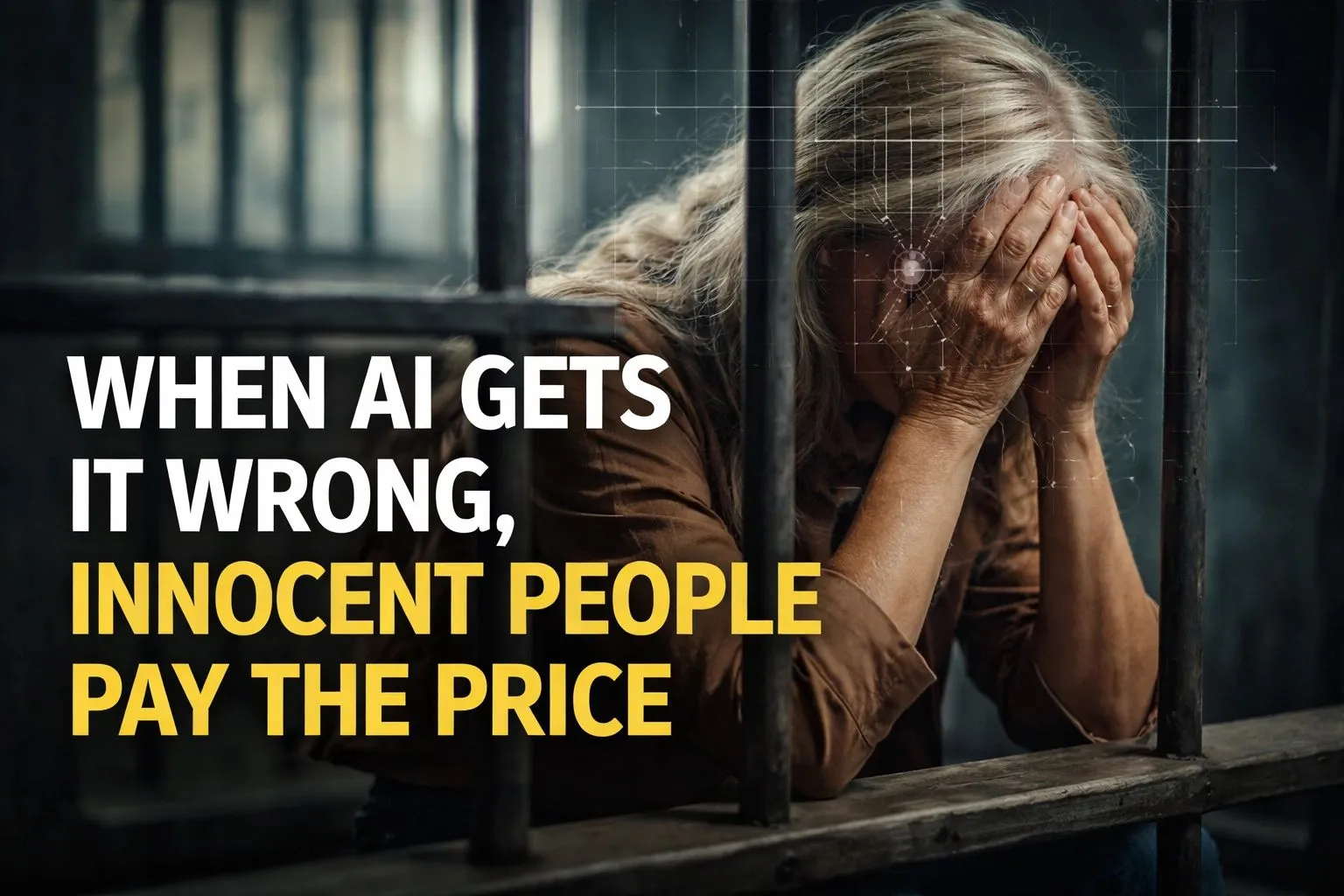
According to multiple reports, Lipps, a Tennessee grandmother, was arrested in July 2025 after facial recognition software linked her to a bank fraud investigation in Fargo, North Dakota, a state she said she had never even visited. She spent months in jail, first in Tennessee and then in North Dakota, before charges were dropped in December after her attorney presented bank records showing she was in Tennessee when the alleged crimes occurred. Reports say the ordeal cost her her home, her car, and even her dog.
Sit with that for a second.
Not hours.
Not a frustrating afternoon.
Not a bureaucratic mistake that got fixed the next day.
Months.
Months of someone’s life gone because a system pointed in the wrong direction and human beings followed it far enough to put handcuffs on the wrong person.
That is what should disturb us most. This was not just a technology failure. It was a human failure wrapped in the language of innovation.
We live in a time where people are increasingly told to trust the machine. Trust the score. Trust the model. Trust the match. Trust the automated recommendation. Trust the system because it is faster, more scalable, and supposedly more objective than people.
But what happens when the system is wrong?
More importantly, what happens when the system is wrong and nobody slows down enough to ask basic questions before someone’s life is destroyed?
That is the real danger. It is not just artificial intelligence. It is artificial confidence.
The most dangerous thing about these systems is not that they can be wrong
It is that people treat them like they are too advanced to question.
In the Lipps case, reporting indicates facial recognition was used as part of the identification process, and her attorney later produced ordinary bank records that undercut the case against her. If simple location evidence could unravel the accusation, then the obvious question is this: why was that diligence not done before someone lost months of freedom?
That question should not only be directed at one department. It should be directed at the broader culture that is forming around AI and automated decision-making.
We are watching society drift toward a model where technology is quietly becoming a first witness, a silent accuser, and in some cases an unearned source of authority.
And the average person is expected to just hope the system gets it right.
That is unacceptable.
This is not an isolated concern
Angela Lipps’s story lands in a broader pattern of concern around facial recognition and wrongful arrest. The ACLU notes that Robert Williams’ case in Detroit was the first publicly reported wrongful arrest tied to a false facial recognition match. Other cases have followed, including Porcha Woodruff’s wrongful arrest in Detroit.
Meanwhile, federal watchdogs have already raised concerns about law enforcement use of facial recognition. The U.S. Government Accountability Office reported that selected DHS and DOJ agencies used facial recognition in criminal investigations and recommended stronger policies, training, privacy protections, and civil rights safeguards.
Even at the technical level, the issue is not settled. NIST has published research documenting demographic differentials in face recognition performance, which is a careful way of saying that error rates and performance can vary across groups and conditions.
So when people act like concern over facial recognition is exaggerated, it is worth remembering this: the concern is not hypothetical, it is documented.
The issue is bigger than one woman and bigger than one police department
Angela Lipps was not just failed by software. She was failed by a chain of human decisions that treated a technological lead as if it carried more certainty than it deserved.
That is the world we need to think harder about.
Because today it is facial recognition in a criminal case.
Tomorrow it could be automated fraud detection freezing someone’s bank account.
- It could be AI-assisted child welfare flags.
- It could be risk scoring in housing.
- It could be predictive analytics in employment.
- It could be a medical system that deprioritizes someone based on flawed assumptions.
- It could be an automated watchlist that follows someone for years.
The pattern is the same every time. A system is sold as efficient. Institutions adopt it because it saves time or money. Oversight lags behind deployment. Then ordinary people end up carrying extraordinary consequences when the system fails.
And too often, the people harmed do not have the time, money, legal help, or public attention needed to prove the machine wrong.
That should scare every one of us.
Because the true divide in the AI era may not be between people who use technology and people who do not.
It may be between people who can fight an algorithmic mistake and people who cannot.
We need to stop asking only what AI can do
We need to ask what it should never be allowed to do without meaningful human accountability.
There is a difference between using technology as an investigative lead and using it in practice as a shortcut to state power. When that line gets blurred, people lose jobs, money, dignity, time, and freedom.
No one should lose months of their life because an algorithm thought they looked like someone else.
No one should be forced to prove their innocence after a black-box process puts them in the crosshairs.
No one should be told this is just the price of innovation.
It is not.
It is the price of weak governance, weak oversight, and a society that is moving faster than its moral discipline.
What should change
This is where public pressure matters.
Lawmakers should be hearing from the public right now about facial recognition, AI-assisted policing, and automated decision systems with real-world consequences.
At a minimum, your representatives should be pushed to support:
- a ban on arrests based solely or primarily on facial recognition matches
- mandatory independent verification before warrants or charges move forward
- full disclosure when AI or facial recognition tools are used in investigations
- audit trails, retention rules, and public reporting on false matches and misuse
- meaningful civil remedies when people are harmed by negligent or reckless deployment
- stronger standards for procurement, testing, bias evaluation, and ongoing oversight
Those are policy choices. Not technical inevitabilities.
The future is not just happening to us. We are permitting certain versions of it.
My view
I am not anti-technology. I am anti-carelessness.
I am anti-surrendering human judgment to systems that still make serious mistakes.
I am anti-building a society where convenience for institutions matters more than due process for individuals.
And I am deeply skeptical of any culture that keeps asking citizens to trust systems that they cannot inspect, challenge, or meaningfully appeal.
Angela Lipps got her freedom back. But getting your freedom back is not the same thing as getting your life back.
That distinction matters.
Because when we talk about wrongful arrests caused by AI or facial recognition, we cannot reduce the conversation to error rates, product claims, or operational policy tweaks. We are talking about human beings whose lives can be fractured by a bad match and an unquestioning chain of authority.
That is not a bug in the future.
That is a warning about the present.
Do Not Be Sheep, Speak Up
Do not just read stories like this and move on.
Contact your city council members, your state legislators, and your members of Congress. Tell them you want strict limits, real transparency, and enforceable accountability for facial recognition and AI-driven investigative tools. Tell them no one should lose their freedom because a machine produced a misleading match. Tell them this issue deserves hearings, legislation, and public scrutiny now, not after more lives are damaged.
If enough people speak up, change becomes harder to ignore.
If we stay quiet, these systems will keep expanding first, and apologizing later.
And by then, someone else will already have paid the price…